Search Articles...
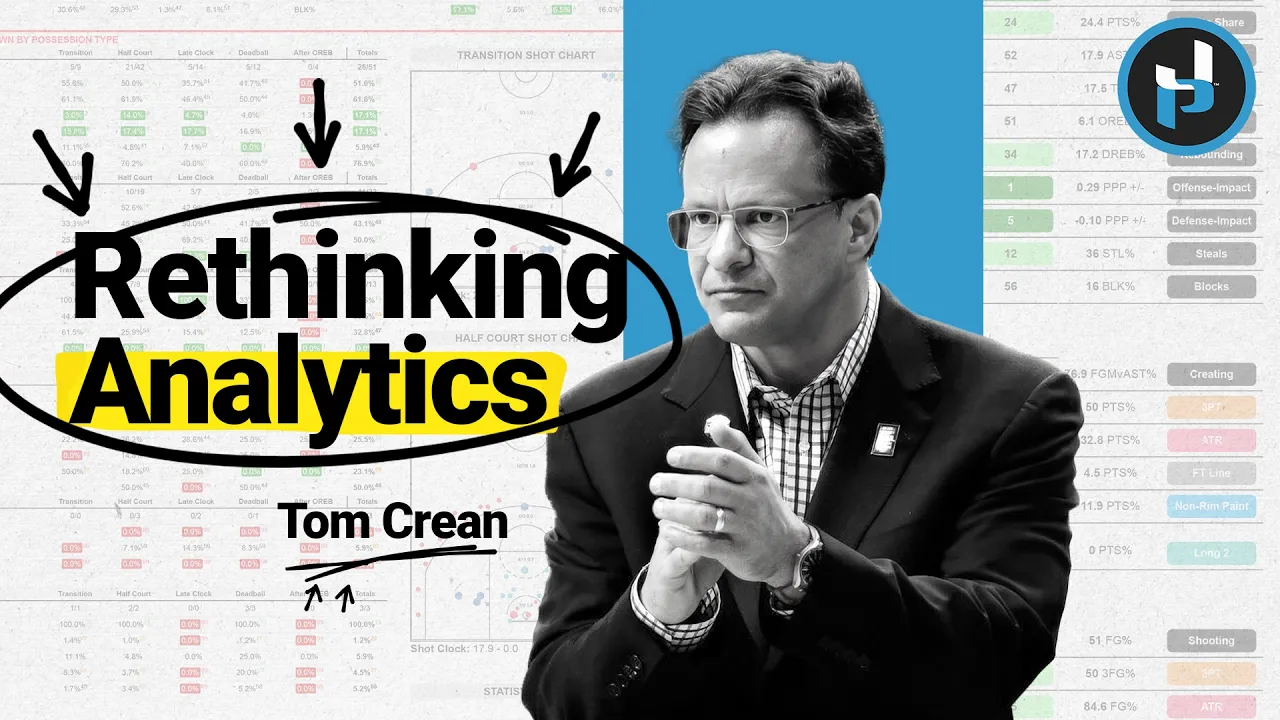
Tom Crean on Basketball Analytics: Eyes, Ears, Numbers
|
Article
The former Marquette, Indiana, and Georgia head coach, now one of college basketball's most prominent broadcast voices, on how coaches should actually use analytics, which stats matter, and what the numbers can never tell you on their own.
Tom Crean carries a book with him everywhere.
It's the Just Play draft book, dog-eared, color-coded, and covered in his handwriting. It went with him onto planes, into studios, and behind broadcast desks throughout the entire 2026 NBA Draft cycle. "I didn't walk into one show without it," he told us. "I didn't walk into one broadcast without it. I'll have it with me in Summer League."
This is a man who has never stopped taking notes. He travels with a legal pad, a full notebook, and a steno pad for the broadcast itself. He keeps player notes going back years. He has never once, in two years, deleted a text message from Chris Hollender, who spent those years walking Crean through Just Play's numbers before leaving to join Clemson's coaching staff. There's too much in those messages worth going back for. As an assistant under Tom Izzo at Michigan State, he was building game plans for the toughest opponents in August, off VHS tape, in 1997.
So when we sat down with Crean, we had a specific question for the coach who spent 22 years on the sideline and developed Dwyane Wade, Victor Oladipo, and Anthony Edwards: how does he actually think about basketball analytics? What we got was a masterclass in the difference between having data and using it.
Inside the Draft Book
So what is this thing he's carrying?
The Just Play draft book is a scouting reference built for the NBA Draft cycle: player by player, the measurements and averages you'd expect, and then the numbers you wouldn't. The stats that explain how a prospect generates his production and where it comes from.
Download the 2026 NBA Draft Book
Those numbers come from Stat Factory, Just Play's basketball analytics engine. It's the research platform where college and professional staffs go to answer the questions a box score can't: how a lineup performs against high-major competition, where a player's points actually come from, who is really driving a defense. The draft book is that engine pointed at a single draft class, printed, and bound. Which is how figures like a plus-366 on/off differential in high-major games end up on national television.
Crean got his copy in Orlando and never put it down. "That's a book I carried around nonstop," he said. "Literally from the time I got it, I was getting on a plane, I took it with me nonstop. So I could always write in it. I could always write notes and go right on down the line."
That last part matters to him. The book lived online too, but a screen can't do what paper does. "Even if I type them out in the phone, I write them. I'd rather have them written out." By the time he sat down for a broadcast, he'd already worked through the book and layered his own notes over Just Play's numbers, because to Crean, "every player, especially as you get in the draft, is a case study unto itself." At a commercial break, he could flip straight to the page.
For him, the book had one job: help him find the number that tells the story he believes about a player. "You're talking about wingspan and height, weight, some averages, who they might be like. But you're trying to come up with something that tells the story that you believe about the player. So if I think a player turns the ball over too much, and the turnover numbers back that up, I'm putting that out there."
And yes, people on set noticed. "Absolutely. They see me carrying it, they can see the cover. I describe it. Now let them look through it." What happened next is telling. "Most people, they're either fascinated by it or they see a bunch of numbers and they don't want to look anymore."
That split, the fascinated and the overwhelmed, is the entire divide in coaching right now. And it's exactly where Crean's framework comes in.
What Is the Eyes, Ears, Numbers Framework?
The eyes, ears, numbers framework is a scouting model with three interlocking circles: what you see on film (eyes), what trusted people tell you (ears), and what the data says (numbers). When all three align, you act. When any one disagrees, you've found a question worth investigating.
Crean learned it from Mark Warkentien, the former UNLV assistant under Jerry Tarkanian who went on to become an NBA Executive of the Year with the Denver Nuggets. This was long before "analytics" became a word coaches argued about.
"If all three of those circles aligned, there weren't many questions to ask," Crean said. "You took it for what it is. But if any one of those circles didn't come together, so eyes and ears, but the numbers don't interlock, well, now you have a discussion. Now you've got to dive in."
That's the whole philosophy in one drawing. The numbers act as a third witness. When all three witnesses agree, you act. When they disagree, you've found the most valuable thing in scouting: a question worth asking.
"I don't need somebody to do my work for me," Crean said. "I like to have somebody that can help my work become clearer."
Crean isn't the first person to draw those circles on a Just Play podcast. When former NBA executive David Morway sat down with us earlier this year, he described the exact same model, a Venn diagram he carried through more than two decades in NBA front offices.
"When there was that small section where they all fit, where they all crossed each other," Morway told us, "we knew that was the perfect player for us."
And his answer for when only two circles align could have come out of Crean's mouth: you get in a room, you find out how passionate your scouts, your coach, and your analytics staff are about their case, and you talk it out.
Two basketball lifers, two interviews months apart, neither one knowing what the other had said, and both reached for the same three circles. It's how the highest levels of the sport have always evaluated players, whether anyone was calling it analytics or not.
How Tom Crean Reads a Scouting Report: Five Minutes on the Clock
We put him in a scenario. You're in a draft room. Five minutes until your pick. What do you pull from the report first?
He didn't hesitate. Notably, none of it was about this season.
"I want to know what the second-year value of this player is," he said. "Where do I think they can be in the second year? What are the biggest things inside of that we've got to get done to get them there? And then the other part of it for me is: what gets them on the floor this year, or why not? If I can answer those questions, I'm good."
Then the numbers, and they change by position. Wings and bigs: free throw percentage, three-point percentage, offensive rebound percentage. Guards: three-point percentage, free throw percentage ("which will tell me a lot"), turnover percentage, and something, anything, that reveals how they finish around the rim.
Notice the shape of that answer. It's three or four numbers reflecting what matters most to Crean, and your priorities are probably different. Those numbers serve two questions: where can this player be in two years, and what's the path to the floor right now? A report like that sharpens the decision the coach is already there to make.
When the Numbers and the Film Disagree
The best example Crean gave us involves Allen Graves, the Santa Clara big man taken in the first round of the 2026 NBA Draft.
The numbers on Graves were emphatic: an elite open-shot maker who hit over 41 percent from three. If you stopped at the stat line, you'd project a floor-spacer who steps into an NBA rotation and does the same thing.
But Crean's eyes told him something the numbers couldn't.
"Allen Graves got so many threes on drop coverage," he explained. "Being at the five, he was being guarded by the opposing five. They'd be in drop coverage, the point guard would swing it back to Allen Graves, spaced away, wide-open three. The numbers tell you, man, he can really shoot. But the film tells you he's not getting threes like this when he gets to the NBA. He's not being guarded by the five like that."
The numbers: Graves was 38/92 from 3 on the year. 23% of his makes (7/19) were in the first 8 seconds of the shot clock and over half of his makes (20/44) in the first 12 seconds and all shots from the top of the key indicating that he was capable of hitting the trail 3 on a ball reversal.
The numbers were true, and the context was everything. "Then all of a sudden you say, whoa, now I see this. This is why this guy's numbers are so good. You feel like you found something, and you can describe something a little better. But without the numbers, without looking at where they're at, you don't necessarily get to that."
Sometimes it runs the other direction, and the eyes catch what the numbers understate. When Duncan Robinson was at Michigan, everybody saw the shooting. Crean saw the help defense. "I thought his intelligence and ability to play off the ball would lead him to a minimum six-year career in the NBA," he said. "And I was way off on that, because it was way better than that." Crean's game plans against Michigan were built to drag Robinson away from the action defensively, so he couldn't protect his teammates.
That's the deeper habit underneath all of it. What Crean hunted was the player the opponent couldn't win without. "It wasn't necessarily the leading scorer. Everybody could see that. Who was the guy they had to have to win, on offense and defense? It could be a passer.
It could be a guy that cuts without the ball. Defensively, in more likelihood, it's the best help defender." The eyes nominate that player. Then the numbers confirm it, and Crean borrows a trick he picked up from Mark Cuban for exactly that.
"He was always looking for outliers. The two-man group, the three-man group, the four-man group. Where were the outlier numbers? He said that's where the story was."
How to Use Plus-Minus and Scoring Data to Tell a Story
When all three circles interlock, the result is a story, and a short one.
When Crean wanted to capture what made Arizona's Brayden Burries a winner before the Milwaukee Bucks took him tenth overall, he reached for one stat from the draft book. In high-major games, with buy games and guarantee games stripped out, Arizona was plus-366 with Burries on the floor and minus-18 with him off it.
"To me, that tells a story," Crean said. "Most people are going to be able to figure that out. Now if I add six other things to it, I've lost them."
Same with Nate Ament, the Tennessee forward the Miami Heat took at thirteen before trading his rights to Milwaukee. Everyone wanted to talk about Ament's three-point shooting. Crean led with a different number: 33.6 percent of Ament's points came from the free throw line. "That is a huge number. Don't get so caught up in his three-point percentages or attempts. Look at how he was scoring and impacting the game."
Run that stat through Crean's own translation rule and it gets even simpler. Ament was essentially guaranteed five points at the free throw line every night in college. That impacts winning. And it travels: getting fouled is a skill that transfers to the next level in a way a college three-point percentage doesn't always.
The same instinct produced his favorite on-air moment of the season. Deep into a Virginia win streak, the numbers showed something strange. Early-clock scoring was way up, and rim protection was climbing week over week. So on SportsCenter, Crean likened a five-game Virginia sample to the San Antonio Spurs.
"When you throw the name Wemby and the San Antonio Spurs and blocks against what Virginia was doing, that gets people's attention. People grasp that. They're going, wow, at home." A wall of block percentages would have washed over the audience, but one comparison, built on the numbers and delivered as a picture, landed.
Why Coaches Don't Trust Analytics: The Filter Problem
If there's a single word that came up more than any other in our conversation, it's filter.
"The player should not have to filter what any of the coaches are saying," Crean said. "They should be able to take it, apply it, and run with it."
His argument is that the same standard applies to data. A stat a coach has to translate in his own head, whether that's offensive rebound percentage, defensive rating, or anything with a decimal point and no context, has already failed. "If you give me something that I've got to think about and I've got to filter, I've got to do math in my head. I don't really want to do that."
So he does the translation himself. Instead of an offensive rebound percentage, he'll tell you a player is grabbing an offensive board every four and a half minutes from the wing, and that they'd better keep him off the glass. Same information, zero filter.
"You take the analytics and you make it fit you," he said. "But the moment you're afraid to look into it, or see if it matches up with what you're seeing on film, you're cheating yourself and you're cheating your team."
He's seen the resistance up close, and he has no patience for it. "Right now people are knocking the analytics and stereotyping analytics. That's so dumb. Baseball had to figure this out, how the person that sees the game could integrate the people that came from the economic and math backgrounds. And it takes time. When people feel like their way is the best way and the other way doesn't matter, Carol Dweck's got a term for that. That's a fixed mindset. I want to have a growth mindset as much as possible."
And for coaches who feel like the water is too deep? Crean's advice is to wade in slowly. "You don't have to go from 20 to 100. You can go from 20 to 40, 40 to 60, and all of a sudden you're building up. Your team feels more confident because you feel confident, because you've got information that gives you an edge in the game."
Which Basketball Stats Matter? Keep, Cut, Question
Late in the conversation, we played a game with him. We'd name a stat, and he'd tell us whether he'd keep it (trust it), cut it (doesn't care), or question it (useful, but only with context). His answers say more about how he evaluates than any framework could.
Points per game? Keep, but he'd take point differential and the split of twos and threes over it every time.
True shooting percentage? Keep, barely. "It's not one of my go-tos." He admits he never fully trusted math he couldn't see. Give him two-point and three-point numbers separately. "It's really what it is."
Assist-to-turnover ratio? Question. "I've never looked at that and said that had a ton of winning variance to me." At Marquette, Indiana, and Georgia, he charted something the box score never saw: the attempted assist. "Did you try to make a pass that led to an assist? I wanted those numbers to be high, four to one, three to one. Delivering a ball that just didn't go in." For team purposes, turnover differential mattered far more.
NBA Combine measurements? Question at best. "I loved selling those in recruiting," he laughed. "I never liked those measurements. They're doing them in bare feet." He'd rather know how many lines a player hit on the three-minute run in his NBA workout.
Defensive rating? Cut. And his reasoning is the three circles in miniature: "As a coach, you're always looking for who's accountable in it. You want to know the one that's really driving it, and the one that's really driving it down." A blended team stat with four other players in it can't answer the only question he cares about.
There's a pattern in every answer: he keeps the stats that assign responsibility and tell him what to do next, and cuts the ones that make him stop and filter.
How Tom Crean Developed Dwyane Wade: The Vision for the Upside
If the numbers are the third circle, it's worth remembering what Crean's eyes have been worth on their own.
Dwyane Wade made one top-100 list in his entire high school career. He didn't start half the time on his own AAU team. He wasn't invited to the camps. Crean's Marquette staff beat out Illinois State and Bradley for him, and stayed on him even when DePaul and Saint Louis showed up late. "If those bigger schools would have recruited him early, we'd have never got him," Crean said.
What the rankings couldn't see, Crean's staff could: a player who got better every single day, including a year he couldn't play at all. During Wade's academic redshirt season, Crean played him at every position in practice, sat him near the front of the bench each game, had him keep stats, had him address the team at halftime, and set up one-on-ones for him whenever a Doug Collins or a Bill Raftery came through. The staff called him from the locker room or the bus after every road win so he never stopped feeling like part of it. Wade made the honor roll that year, and left Marquette on time to graduate.
"It was always about having a vision for the upside," Crean said. And it built a conviction he carried for the rest of his career: "Whether they're helping you win right now or not, if they can impact losing, you better make sure they can impact winning."
Ask him for the common denominator between Wade, Oladipo, and Edwards and he doesn't reach for a stat. "Work ethic. Extra work, without question. Late at night, in the morning, and never enough." They were never privileged. They kept their circles tight. And each one had a defensive calling card long before the offense caught up: Wade off the ball, Oladipo and Edwards on it. "They didn't necessarily have everything at that point defensively, but they had things that were calling cards that grew into having more and more."
No algorithm flags that. But the numbers, Crean would tell you, confirm it fast once you know where to look. Eyes first, then the circles.
Coaches Have Always Used Analytics. They Just Didn't Call It That.
Here's the thing Crean wants coaches to understand: they've been doing analytics their whole careers under a different name.
He learned from watching Mike Krzyzewski that getting into the bonus by the 12-minute mark of each half correlated with winning at an incredible rate. So every time his teams reached five fouls drawn, he was hunting seven. Every time they hit eight, he was hunting ten. At Marquette, his staff charted every four-minute segment between timeouts, win it or lose it, decades before a platform could do it for them. "Now, analytics, numbers, individual stats, team stats, that tells you how important that is. And you don't have to have genius-level thinking to figure that out. That's why people shouldn't be scared of it."
That's the frame he keeps returning to. The numbers sharpen a coach's eyes and ears, and they take the emotion out. "They give you a real professional view," he said. "It lets you stay factual and not just opinionated. And I get sick of opinions, because I know sometimes where they're coming from. I feel there's a lot more people out there like me, that want the truth, that want to be smarter."
Twenty-two years as a head coach. Hundreds of broadcasts. Three circles.
And one book he won't leave home without.
"If I was coaching tomorrow," Crean said, "I'd be having Just Play put in before I'd have the staff done."
Frequently Asked Questions
What is the eyes, ears, numbers framework in basketball scouting?
It's a three-circle evaluation model: your eyes (what you see on film and in person), your ears (what trusted evaluators tell you), and the numbers (the data). When all three align, you act on the evaluation. When any circle disagrees with the others, that disagreement marks exactly where to dig deeper. Tom Crean learned it from longtime NBA executive Mark Warkentien, and former NBA executive David Morway has described the same model as a Venn diagram he used throughout his front office career.
Which basketball stats does Tom Crean trust most?
Crean prioritizes stats that assign responsibility and suggest an action: point differential, two-point and three-point splits, turnover differential, free throw rate, and on/off plus-minus in high-major games. He's skeptical of blended stats like defensive rating that spread accountability across five players, and he questions assist-to-turnover ratio and combine measurements without context.
How should coaches introduce analytics to their team?
Gradually, and in translated form. Crean's advice is to go "from 20 to 40, 40 to 60" rather than from 20 to 100. Adopt one or two numbers that map to how you already think, and convert percentages into plain language players can act on immediately (an offensive rebound every 4.5 minutes, not an offensive rebound percentage). A player should never have to filter what a coach or a stat is telling them.
How did Tom Crean use the Just Play draft book for the 2026 NBA Draft?
He carried it into every broadcast and show of the draft cycle, annotating it by hand and leading his on-air player evaluations with single, story-driving numbers from it, like Nate Ament scoring 33.6% of his points at the free throw line, or Brayden Burries' plus-366 on/off differential in high-major games.
Tom Crean was the head coach at Marquette, Indiana, and Georgia across 22 seasons and now serves as a college basketball analyst. This conversation has been lightly edited for length and clarity.