Search Articles...
The Hardest Job in College Basketball Has a Blueprint
|
Article
NBA veteran David Morway spent 25 years building winning front offices in Indiana, Milwaukee, and Utah. Now he's watching college basketball try to do it in real time, and he has something to say.
David Morway doesn't sugarcoat it.
"I honestly don't know how the coaches are doing it," he says.
From almost anyone else, that might sound dismissive. From a man who spent more than two decades as an NBA front office executive, helping build the Reggie Miller–era Pacers, drafting Giannis Antetokounmpo in Milwaukee, and developing Donovan Mitchell in Utah, it sounds closer to respect. It also sounds like a warning.
College basketball is in the middle of a revolution. NIL has turned programs into de facto professional franchises. The transfer portal has made roster construction an annual sprint. General manager roles are being invented on the fly, staffed by people who are talented, motivated, and, more often than not, operating without a roadmap. The institutions are catching up, but slowly.
Morway has watched all of this unfold from the outside. Over 25 years at three NBA franchises, he built a framework he believes can help.
A Career Built on Both Sides of the Table
Before Morway ever sat in a front office chair, he spent a decade as an agent. That background gave him something rare: a real understanding of what players need from an organization, not just what organizations need from players. It also handed him a steep learning curve. In the early 1990s, Donnie Walsh, the legendary president of the Indiana Pacers and, in Morway's words, "a Hall of Famer in the business," asked him to switch sides.
"When I got to the NBA, I realized I didn't know anything about basketball," Morway admits. "Not at the level you need to understand it when you're on the team side."
He spent 14 years in Indiana learning under Walsh and later Larry Bird, whose memory for the game bordered on the supernatural. "He could be watching a game from 15 years ago and tell you the next play that was going to happen," Morway recalls. "I used to sit there and think — how does he do that?"
From Indiana, Morway joined the Milwaukee Bucks as a front office executive, where the team would eventually draft an 18-year-old from Greece named Giannis Antetokounmpo with the 15th pick. From there he went to Utah, where he helped develop Donovan Mitchell and a Jazz team that would push all the way to a seven-game series in the bubble before falling to Denver.
Three markets, three championship-caliber builds, and twenty-five years of lessons.
Culture Is Not a Poster on the Wall
Ask Morway what separated the programs that won from the ones that didn't, and he doesn't hesitate.
"Culture is a living organism," he says. "It changes every day."
That framing matters. Culture, in his experience, isn't a mission statement or a values document. It's the daily behavior of everyone in the building, from the people maintaining the facility to the general manager to the players on the floor. And players, he points out, have an almost uncanny ability to detect when leadership isn't living what it preaches.
"If you're talking one thing and doing something else," he says, "the players sniff it out right away."
Building real culture, in Morway's model, comes down to three things: communication, role clarity, and accountability. Leaders have to communicate who they are constantly. They have to assign roles with enough specificity that people know exactly what's expected. And then they have to hold the organization accountable for outcomes, not just individuals but the group.
"I used to tell our guys all the time: how did we get better today?" he says. "If we didn't get better today, we got worse. Because everybody else in the league is getting better."
Austin Barone, who worked alongside Morway and helped facilitate the conversation, puts it simply: "Inspect what you expect." Morway used the phrase at a speaking event Barone attended years ago, and it stuck. It's short, and it's entirely operational.
What the Tape Couldn't Tell You
In 2013, the Milwaukee Bucks held the 15th pick in the NBA Draft. The player they were considering, a teenager from Athens who had played most of his basketball in a Greek third-division league, was almost impossible to evaluate by conventional means.
"He was playing Division III level, so the tape was next to worthless," Morway says. "There weren't a lot of analytics. His medicals weren't available. He wasn't made available to teams to interview."
What they had was the belief of John Hammond, Milwaukee's GM, and the conviction of owner Senator Herb Kohl. Atlanta, holding picks 16 and 17, reportedly loved him too. The Bucks took the shot.
"Nobody knew Giannis was going to be this," Morway says plainly. "If anybody says they knew, they didn't know."
What no scout, no model, and no interview process could have surfaced was what was inside Giannis: the competitiveness, the commitment, the relentless drive to become something no one could have imagined at 15. Morway watched it emerge in real time.
"Quickly over time, we started to see it," he says. "Oh, holy cow — this kid's got a chance to be on a whole other level."
The Giannis story isn't a cautionary tale about analytics. It's a reminder of what evaluation actually is: a structured attempt to get as close as possible to a truth that is never fully knowable. That idea brings Morway to his framework.
Eyes, Ears, and Numbers
If there's one concept that threads through Morway's entire career, it's what he calls the Venn diagram: three overlapping circles representing everything a front office can know about a player.
Eyes: what the scouts see on tape and in person. How does the player move? What's his court IQ? How does he respond when the game slows down?
Ears: the intel. What do people say about him? Coaches, teammates, agents? What do you hear when the cameras are off?
Numbers: the analytics. Not a single rating or composite score, but customized metrics built around the specific system and style of play a program runs.
"When we looked at it like a Venn diagram," Morway says, "and when there was that small section where they all fit — where they all crossed each other — we knew that was the perfect player for us."
But the real world rarely delivers perfect overlap. So how do you decide when only two of three align?
"You get in a room," he says. "You ask how passionate are your scouts about what they're seeing. How passionate is your coach about this player fitting the system. How passionate is your analytics staff that the numbers are right — or wrong. And then you talk it out."
The key word is passion. Not certainty, which is rarely available, but passion, which in Morway's experience tells you something about conviction. And conviction, interrogated by a room full of smart people who trust each other, tends to surface the right answer more often than any single data point.
He's emphatic about one more thing: customization. The era of universal player ratings, a single number meant to capture every player's value regardless of team or system, has always frustrated him.
"I struggled with single-number player ratings," he says. "What Rick Carlisle did with Indiana and his system — that pace, the full-court pressure, the transition game — you've got to build your metrics around the players that can play that system. It changes everything."
The College GM Has It Harder
After three decades at the highest level of professional basketball, Morway has reached a conclusion that surprises people: the general manager role in college athletics, the position now being created at programs around the country, may actually be more demanding than its NBA counterpart.
"In the NBA, we're scouting all year long," he says. "We have big staffs. College GMs are not only recruiting their own players back every year — they have to scout every player in Division I, Division II, Junior College and NAIA. And then they have to have all those decisions made within a very short timeframe when the portal opens and closes."
And that's before the financial piece. There's no collective bargaining agreement, no standardized salary structure. Players and agents operate under their own rules, and the market shifts constantly.
"How do you evaluate whether a player is worth $600,000 or a million dollars or a million and a half?" Morway asks. "There's very little information. It's really hard."
His advice is unambiguous: coaches should not be in those conversations at all.
"If a coach is negotiating a player's salary and then has to coach him — that's a terrible setup," he says. "The general manager should be handling those conversations. The coach should be coaching. An agent has a responsibility to their player. They don't have a responsibility to the program. Coaches shouldn't be in rooms like that."
The broader point is that the roles have to be separated, defined, and protected. Programs that haven't done this yet aren't behind because they're lazy. They're behind because everything changed at once and no one had a roadmap.
"It's the Wild West," Morway says. "There's no collective bargaining. Teams are trying to react and catch up. Some have reacted quicker than others. But everybody's trying to figure it out."
Building It Before the Portal Opens
So what does Morway actually recommend for the program trying to build this for the first time?
His first piece of advice is to start before the window opens. "You have to have your system and your process in place well before the portal opens," he says. "If you're building it during the portal, you're already behind."
Next, build a database and know your universe. "The database, from the beginning, is absolutely essential," he says. Who are the players that fit your profile? What system are you running? What kind of character, on and off the court, are you building around? Get clear on that before the pressure hits.
Then use all three lenses: eyes, ears, and numbers, with the numbers calibrated to your program rather than someone else's.
Finally, evaluate the same way every time. Whether you're looking at a McDonald's All-American, a mid-major standout, or a transfer from a power conference, apply the same process. "If you have the right process in place," he says, "you can evaluate them all the same way."
It sounds straightforward. In the middle of a portal window, with scholarship dollars on the line and a coaching staff looking for answers, it is anything but.
That difficulty is why Morway keeps showing up, talking to GMs, mentoring coaches, and trying to give back to a game he admits gave him more than he expected.
"I was a kid from nowhere who ended up as a general manager in the NBA," he says. "How the hell did that happen? So yeah. I feel like I have to give it back."
College basketball could use a few more conversations like this one.
Hear the full conversation with David Morway on the new college front office reality, what college programs can learn from NBA roster building, and the stories behind evaluating players like Giannis Antetokounmpo, Donovan Mitchell, and Paul George.
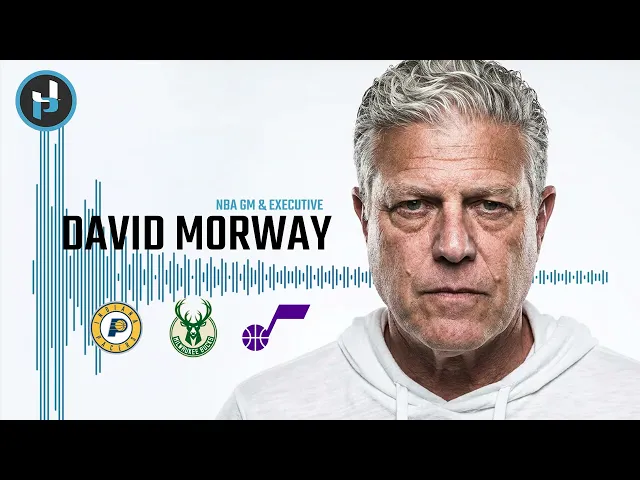
David Morway served as a front office executive with the Indiana Pacers, Milwaukee Bucks, and Utah Jazz over a 25+ year career in the NBA.